
A practical guide for parents of middle- and high-school students.
A new school year usually starts with good intentions. Students promise to keep up with assignments. Families buy planners, organize desks, and talk about starting strong.
Then the pace picks up.
A project appears in one class, a test lands in another, practice runs late, and the carefully planned routine starts to slip. When that happens, students often hear that they need to work harder or be more organized. But effort is rarely the whole problem. Many students need a system they can use when school gets busy.
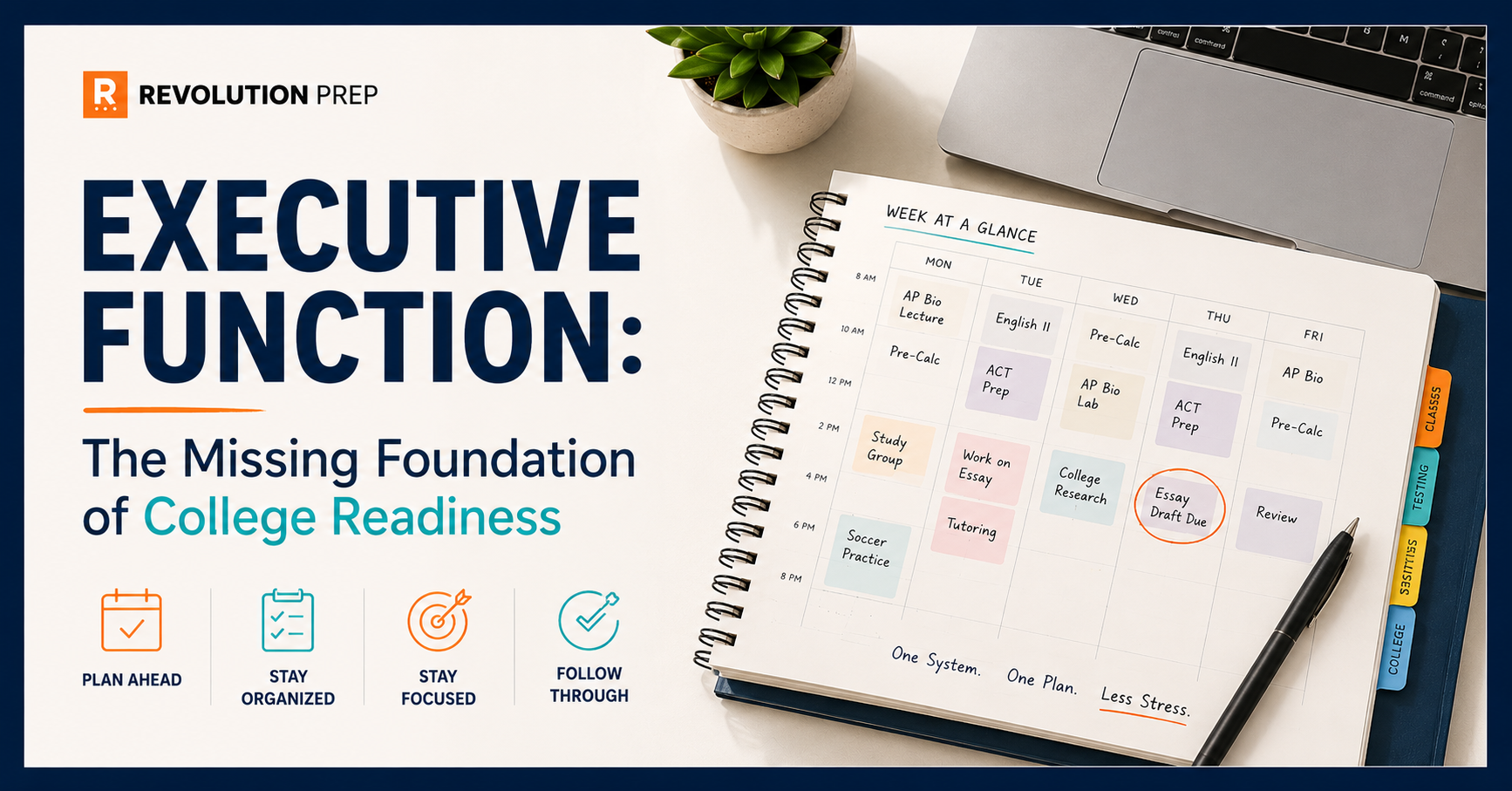
That is where executive function comes in. Executive function is the set of skills students use to plan, focus, adjust, and follow through. It helps a student remember what is due, decide what to do first, notice when a study strategy is not working, and ask for help before a small problem becomes a bigger one.
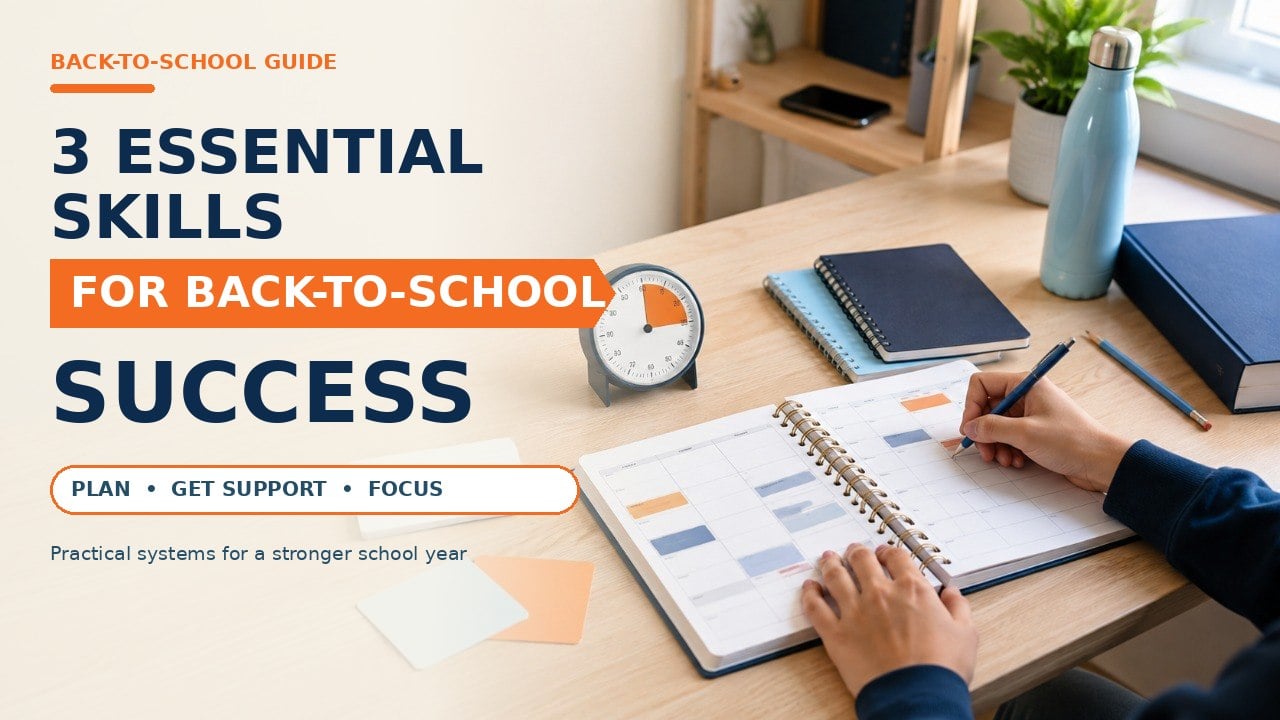
These three habits give students a practical place to start.
1. Put every deadline in one place
The type of planner itself does not matter much. A student can use Google Calendar, Notion, a school-issued agenda, or a paper planner. What matters is having one place where every assignment, test, meeting, and deadline lives.
When information is scattered across class portals, sticky notes, text messages, and memory, students have to reconstruct their week every time they sit down to work. That takes energy and makes it easier to miss something.
A 15-minute "Weekly Download" can prevent that scramble.
How to do a Weekly Download
Once a week, preferably on Sunday, your student should:
- Open every class portal.
- Add each assignment, quiz, test, paper, and project deadline to one planner.
- Mark fixed commitments such as practices, games, appointments, and family plans.
- Look for busy days and decide when larger assignments will get done.
- Flag any class that will be missed and contact the teacher before the absence.
- Set up the first Weekly Download together.
- Choose one planner or digital calendar and move every deadline into it.
- Identify which teacher's office hours you'll attend each day, before you need help.
- Draft one help-seeking email.
- Try one 30-minute work block with the phone in another room.
Color coding by class or assignment type can make the week easier to scan, but keep the system simple enough to maintain. A beautiful planner that gets abandoned after two weeks is not useful.
Parents and guardians can help build the habit without taking over. Sit with your student for the first few Weekly Downloads. Ask questions such as, "What is due first?" or "Which day looks crowded?" Let your student enter the tasks and make the decisions.
Add a 60-second brain dump
Planning tells students what to study. A quick brain dump shows them what they actually know.
After reviewing a topic, the student closes the notebook, puts the phone away, and writes everything they can from memory. Then the student checks the notes, circles what was missed or misunderstood, and studies those gaps.
This is more useful than repeatedly rereading a page that already feels familiar. The brain dump forces the student to retrieve the information, which makes weak spots easier to address.
It works in almost any subject. A student can list the steps in a math process, sketch a science concept, write the causes of a historical event, or summarize a chapter from memory.
Students should regularly review their system with parents or guardians to ensure it’s being used consistently and adjusted for success.
2. Build a support bench before it is needed
Students often wait too long to ask for help. They may feel embarrassed, hope the problem will resolve itself, or simply not know how to ask.
The start of the year is a good time to identify where help can come from. That support bench might include:
- Identify teacher office hours
- Join a small study group with classmates
- Use a school peer-tutoring program
- Consider a professional tutor for steady one-to-one support
- Create a distraction-free workspace by putting your phone away.
- Turn off notifications on your laptop.
- Keep water, a calculator, chargers, and needed materials within reach.
- Choose one task for each work block.
- Set a visible timer to mark the start and end.
- Build one system for the week instead of simply trying "be more organized."
- Plan what to ask your teacher and when to go for help.
- Reflect after a test: "What will you change before the next test?"
- Ask: "What would make it easier to start?" when a task feels hard.
The goal is not to use every resource all the time. The goal is to know the options before the student feels stuck or overwhelmed.
Teacher office hours are often the easiest place to begin. A general or specific question also gets a better response than "I don't understand anything."
Students can use this email script:
Hi [Teacher],
I'm in your [period] [class]. I'm having trouble with [specific topic]. I've tried [what you've done], but I'm still stuck on [specific part]. o you have an upcoming free block or time when I can come in [time] to get some help?
Thank you,
[Name]
The sentence "I've tried..." matters. It helps the student explain the work already done and gives the teacher a clearer starting point.
Parents can coach this process without becoming the messenger. Help your student identify the problem, draft the note, and choose a time to follow up. Then let the student send it. (Don’t forget to add it to your calendar!)
3. Design the study space and use a timer
A student does not need a perfect home office. A kitchen table can work. The important part is making that space easier to focus in before the work begins.
A simple setup looks like this:
Moving the phone matters because resisting it is work. Every notification, vibration, or quick check creates another decision. Distance removes the decision.
Once the space is ready, students can use focused work blocks instead of an open-ended study marathon. Try 30 minutes of focused work followed by a five-minute break. After three or four rounds, take a longer break of 20 to 30 minutes.
During the short break, the student should stand up, stretch, refill water, or walk around. Opening social media for "just a minute" can easily turn into doomscrolling and make it much harder to regain focus.
Thirty minutes is only a starting point. Younger students or students who struggle to begin may do better with 15 or 20 minutes. Students who already concentrate well may prefer longer blocks. The timer should support attention, not become another rule to fight.
How parents and guardians can help without becoming the project manager
When a student falls behind, parents and guardians often end up tracking every deadline, checking every portal, and repeating reminders. However, it’s unsustainable, and it does not teach the student how to manage their own systems.
A better approach is to shift the conversation:
The aim is not to remove every struggle. It is to help students notice what is not working and choose a better next move.
A simple plan for this week
Do not overhaul the entire school routine at once. Pick one action:
Once that new action becomes routine, add the next.
Students do not need to become perfectly organized before they can have a strong year. They need a few dependable systems that still work on busy weeks. A single planner, a prepared support bench, and focused work blocks give them somewhere to return when the year gets complicated.
Want help building a plan that fits your student? Schedule a free Academic Planning Session with a Revolution Prep Academic Coach. Together, you can identify what is getting in the way and choose practical next steps for the school year.

Getting ready for the SAT or ACT? Take a free Revolution Prep practice exam to establish a starting point and plan what to work on next.