


Updated: August 2026
If your student has taken the SAT or ACT more than once, there's a good chance the score that matters most to a college isn't from either test date alone. It's a blend of the best sections across both.
That's called superscoring, and it's one of the most useful things to understand before deciding whether a retae is worth it.
How superscoring actually works
For the SAT: a school that superscores takes a student's highest Reading and Writing section score and their highest Math section score, even if those two scores came from different test dates, and combines them into a new, higher total.
For the ACT: it works section by section. A school that superscores builds a composite from a student's best English, Math, and Reading scores across every test date on file. (Science used to factor into ACT's own official Superscore Composite; as of the current ACT scoring model, the Composite is calculated from English, Math, and Reading only.)
The practical effect: a student doesn't need one great test day. They need one great Reading and Writing section on any date, and one great Math section on any date, or one great score in each ACT section across however many attempts it takes. That's why most students who improve meaningfully do it across 2 to 3 official attempts rather than one.
Colleges known to superscore
Superscoring policies vary school to school and can change from year to year, so treat this as a starting point, not a guarantee. Always confirm directly on the school's own admissions page before making a testing decision.
- Cornell University — superscores the SAT (highest section scores across dates) and considers the ACT-provided superscore. Cornell's Standardized Testing Policy
- Dartmouth College — automatically superscores both the SAT and ACT, taking the highest result on individual sections regardless of test date. Dartmouth's Testing Guidelines
- University of Pennsylvania — superscores both the SAT and ACT, combining the highest Reading and Writing score with the highest Math score across dates. Penn Admissions: Testing
- Yale University — superscores both tests and will recalculate an ACT composite from a student's best section scores across administrations. Yale Admissions: Standardized Testing
- University of Georgia — superscores both the SAT and ACT, taking the highest sub-scores from each test a student has taken (though UGA does not mix and match between the SAT and ACT). UGA Admissions: UGA and Test Scores
For the ACT specifically, ACT's own explanation of how its superscore is calculated is a useful reference: ACT Superscore FAQs.
Superscoring policies are set by each individual college and can change from year to year. The information above reflects each school's publicly posted policy at the time of writing. Always check the school's own admissions website for the most current policy before making a testing decision, and don't hesitate to reach out to the admissions office directly if anything is unclear.
What this means for retake strategy
If a school on your student's list superscores, a second or third attempt isn't starting over. It's a chance to lock in the sections that are already strong and put focused prep time into the one section holding the composite back, without any risk of a strong section score getting "erased" by a weaker sitting elsewhere.
Most colleges let students choose which scores to send, and a superscoring school is looking for the strongest sections regardless of what else is on file. A small number of colleges do ask for every sitting, so it's worth a quick check against the list. Even at those schools, a weaker date doesn't pull the superscore down. It just sits alongside it.
This is exactly why we recommend most students plan for 2 to 3 official test dates rather than treating the first attempt as the only one that counts. Both the College Board and ACT offer fee waivers that cover multiple test dates for students who qualify. It's worth confirming eligibility before building a testing calendar around a number of attempts a family can't comfortably sustain.
Know when to stop: the diminishing-returns signal
A retake is only worth it while it's still moving the number. Three signs it's time to stop testing rather than book another date:
- The score is already at or above the 75th percentile for the schools on the list. At that point the student is competitive; another attempt is chasing a number the school doesn't need.
- Multiple attempts have plateaued. If the last two sittings gained fewer than 30 SAT points (or the ACT equivalent), another attempt is unlikely to move the needle much further.
- The transcript already tells the story. A student already taking AP Calc BC or AP Physics C has demonstrated academic readiness in a way admissions
officerscommittees weigh heavily, sometimes more than an incremental score gain.
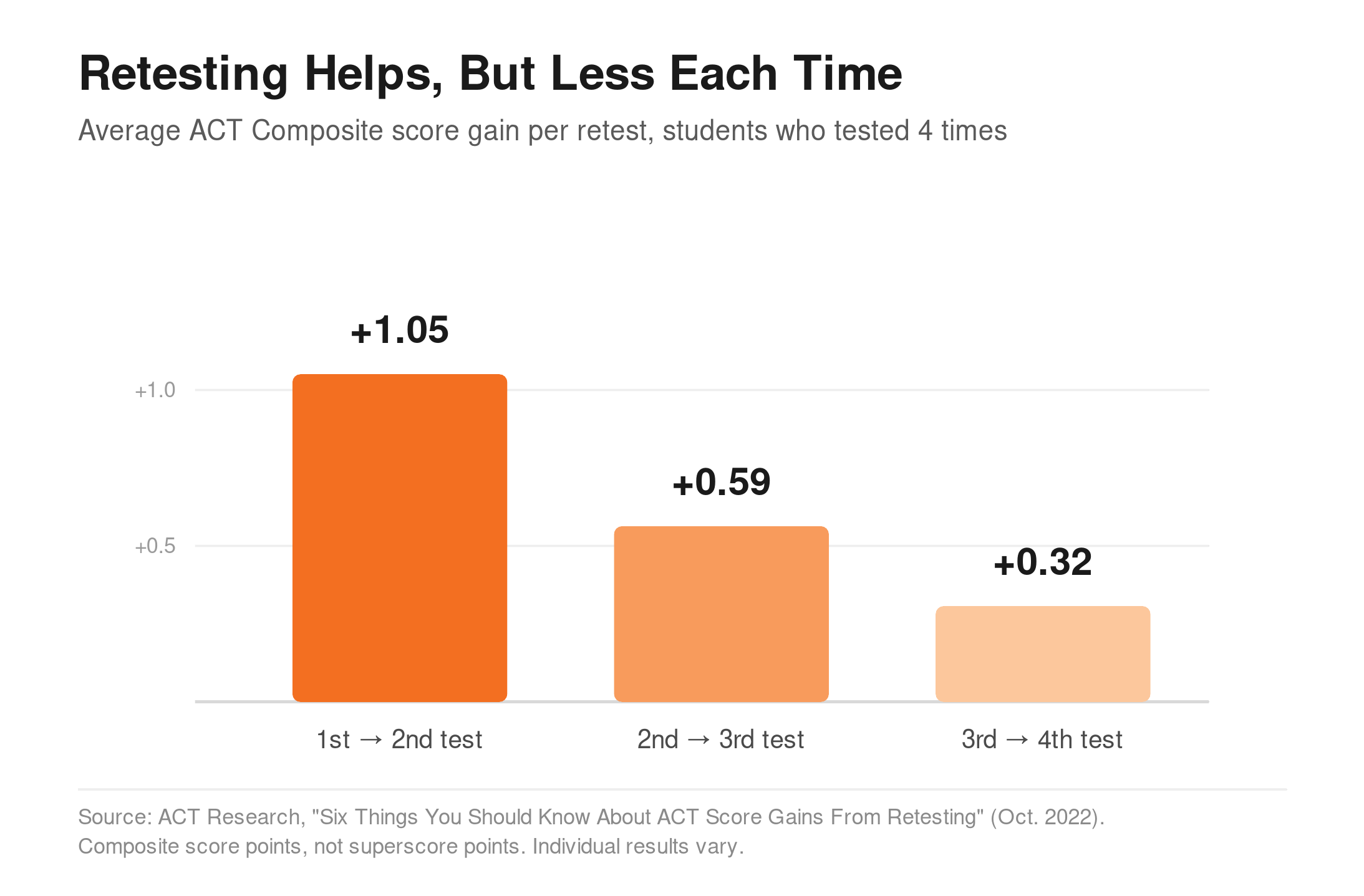
The data backs this up: ACT's own research on retesting found that score gains shrink with each additional attempt. Students who tested four times gained an average of 1.05 points from their first to second test, 0.59 points from second to third, and just 0.32 points from third to fourth. The pattern holds for superscore gains too, they get bigger with more attempts, but each additional attempt adds less than the one before it.
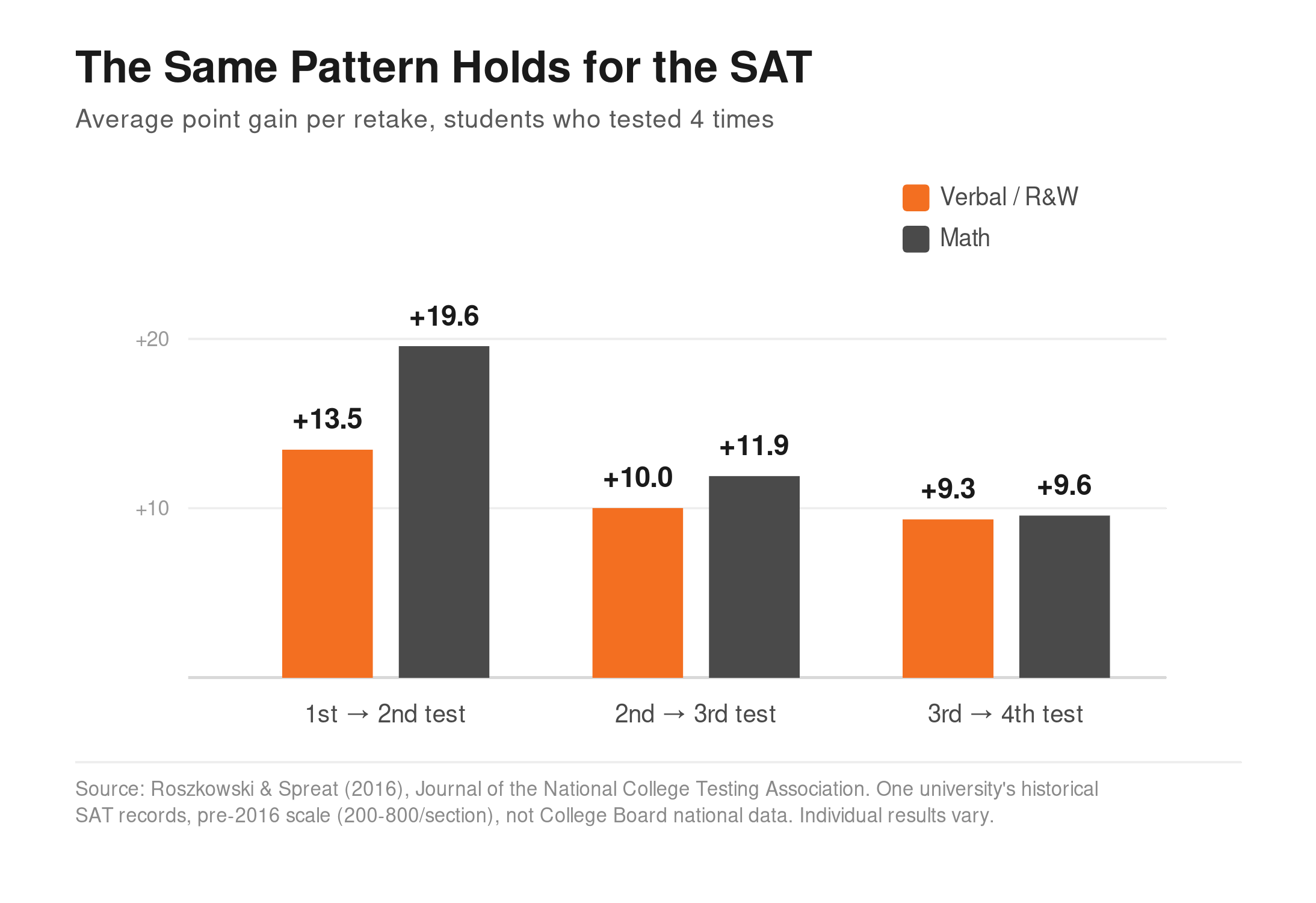
The same taper shows up on the SAT. An academic study of one university's SAT records found Verbal/Reading & Writing gains of about +13.5, then +10.0, then +9.3 points per retake, and Math gains of about +19.6, then +11.9, then +9.6. The SAT's decline is more gradual than the ACT's, the study's authors describe it as real but modest, but the direction is the same: the biggest jump comes early, and each additional attempt buys less than the one before it.
Stopping is a strategic decision, not a concession. Every additional test date costs money, but the bigger cost is often hidden: the time and mental energy that could go toward the extracurriculars, leadership, and genuine intellectual interests that make an application stand out. If your student is already competitive, that trade-off usually isn't worth it.
When a retake, not a superscore, is what unlocks the money
The stopping signals above are about admissions competitiveness. Merit aid runs on a separate calculation, and it can justify a retake your student doesn't strategically need for admission.
Superscoring isn't the only reason a retake matters. At many schools, a single test date crossing a specific threshold unlocks a jump in automatic merit aid, and that's a different mechanism worth knowing about.
The University of Alabama publishes its out-of-state automatic scholarship grid by score band: a 1330 to 1350 SAT (with a 3.5+ GPA) qualifies for the Foundation in Excellence award, $15,000 a year. A 1360 to 1410 SAT qualifies for UA Scholar, $24,000 a year. That's a $36,000 difference over four years for closing a 10-to-60-point gap on a single retake.
One important distinction: UA scholarships are based on a student's official score from a single test date, not a superscore. UA's own scholarship policy states scores are not superscored for merit purposes. So, while the schools listed above reward a student's best sections across multiple dates, a school like UA rewards the best single sitting. Both are good reasons to retake; they just work differently, and it's worth checking which kind of policy applies to each school on your student's list before deciding whether (and how) to prep for another attempt.
Have a question about retakes or superscoring? Connect with a test expert today!

Testing and admissions policies change frequently and vary by institution. This article is for general informational purposes and is not a substitute for the current policy published on each college's own website. Please confirm directly with each school before making decisions about testing.